


Be bold,
back the brave
We aim to build a €100M fund to secure access to news in every European country.

Catherine Miller, Co-Director of the European AI & Society Fund, reviews Madhumita Murgia’s Code Dependent, a deeply reported account of how AI is reshaping lives far beyond Silicon Valley; and who benefits, who decides, and who bears the cost.
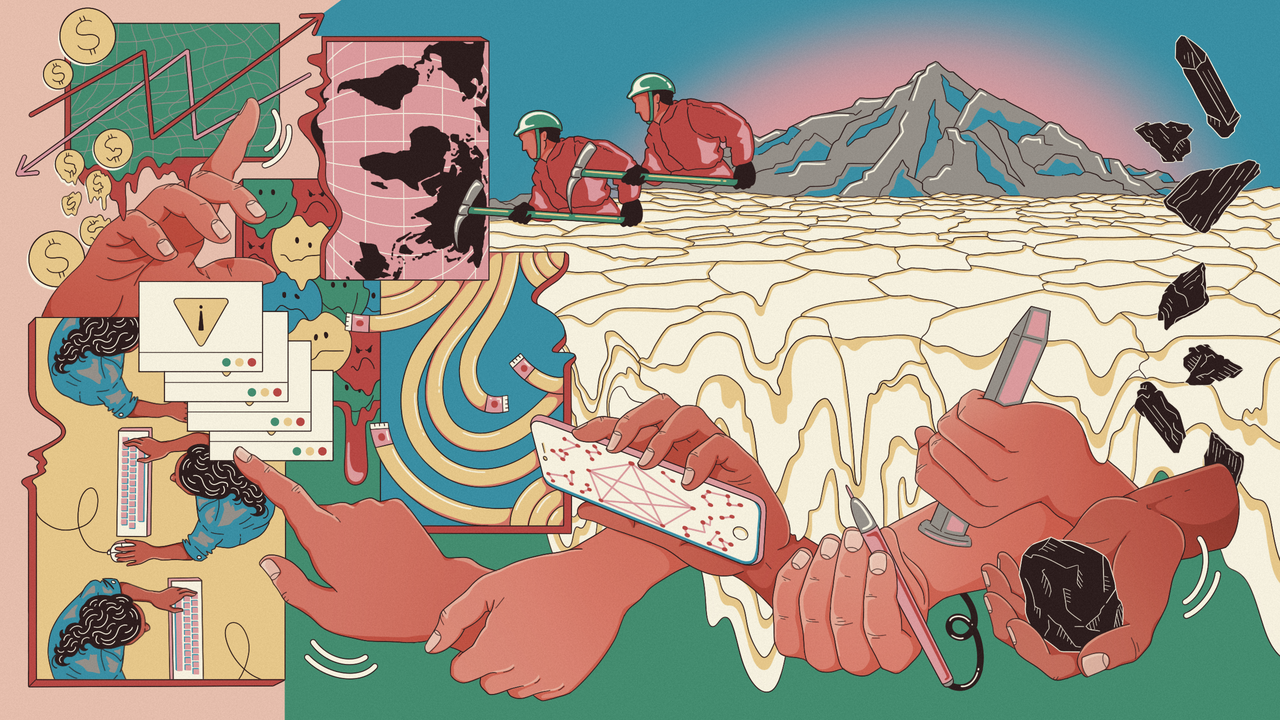
Ashita is a doctor fighting tuberculosis in rural India. Hiba is an Iraqi refugee who’s exiled in Bulgaria. Helen is a poet in the English town of Sheffield. Carla is a teenage mum in Salta, Argentina. They live entirely separate lives across all corners of the globe, but what they have in common is that they live – as we all do – “in the shadow of AI.”
In Code Dependent, Madhumita Murgia tells the stories of people far from Silicon Valley whose lives are being transformed by Artificial Intelligence. A trained scientist, Murgia is Artificial Intelligence Editor of the Financial Times and an alumna of Wired Magazine with an “innate optimism” about technology. This makes her critique of the social impacts of AI fair minded and complex. She wants AI to deliver on its potential to do great things, yet she cannot ignore the “different darker tale” that emerges from her reporting.
Ashita, the doctor, is also an optimist. As she battles rampant TB in indigenous communities, an AI app is a “great blessing”, providing a mechanised second medical opinion. Her story seems to embody everything we have been promised that AI could do for people and society. Yet Murgia zooms out to the wider dynamics. Health tech companies are drawing data from communities like Ashita’s to develop products they will sell back as a premium service. For Ashita, the equation works now but, as she drily notes, “if you tell me it’s going to cost extra for my patients, I’m out. I’d rather buy them eggs”.
Hiba’s story too is nuanced. Her work as a data labeller, providing the raw material for AI systems, is a lifeline for her family, uprooted by war from their home in Iraq. But it’s also a trap. The work is enough to keep their heads above water, but not to build a life. Their dependence means the contractor can change the rules and rates and they are powerless to complain. As Mercy Mutemi, a lawyer working on behalf of data labellers in Kenya tells Murgia, “all revolutions are built on the backs of slaves. So if AI is the next industrial revolution, then those who are working in AI training and moderation, they are the slaves for this revolution”.
The thread that runs through Murgia’s book is data colonialism. In Salta Argentina a Microsoft AI prediction system is supposed to identify girls at risk of teenage pregnancy. The local government officials that introduce it are well intended. But it is both ill-conceived and badly executed and the project is abandoned without any apparent impact on the complex social problem it aimed to solve. But for Microsoft, it’s part of a “wider strategy to increase its political clout. Like the colonial mega-corporations of centuries gone by – the East India Company, say or the Anglo-Iranian Oil Company – technology companies today are beginning to function as monopolistic quasi-states.”
Writing a book about AI is a brave endeavour. Not only is it hugely complex, there is a risk that by the time you publish everything has moved on. But the stories we hear in Code Dependent have only become more relevant. The story of Helen, the English poet, whose life was shattered when her face was applied to disturbing and graphic pornographic images, is even more poignant now, knowing that generative AI developments have made these practices even easier. There is perhaps some hope, however, that where Helen could find no redress, there is now an investigation into Grok’s proliferation of nudified images, thanks to the legislation the European Union has passed.
For those of us who fight for technologies to serve the public interest, it is often frustratingly difficult to explain why it all matters in ways that make sense to those outside our bubble. Murgia has done that – and more – in this remarkable book that moves with agility between the very human lives that sit in the shadow of AI and the global trends that are driving its direction.

